
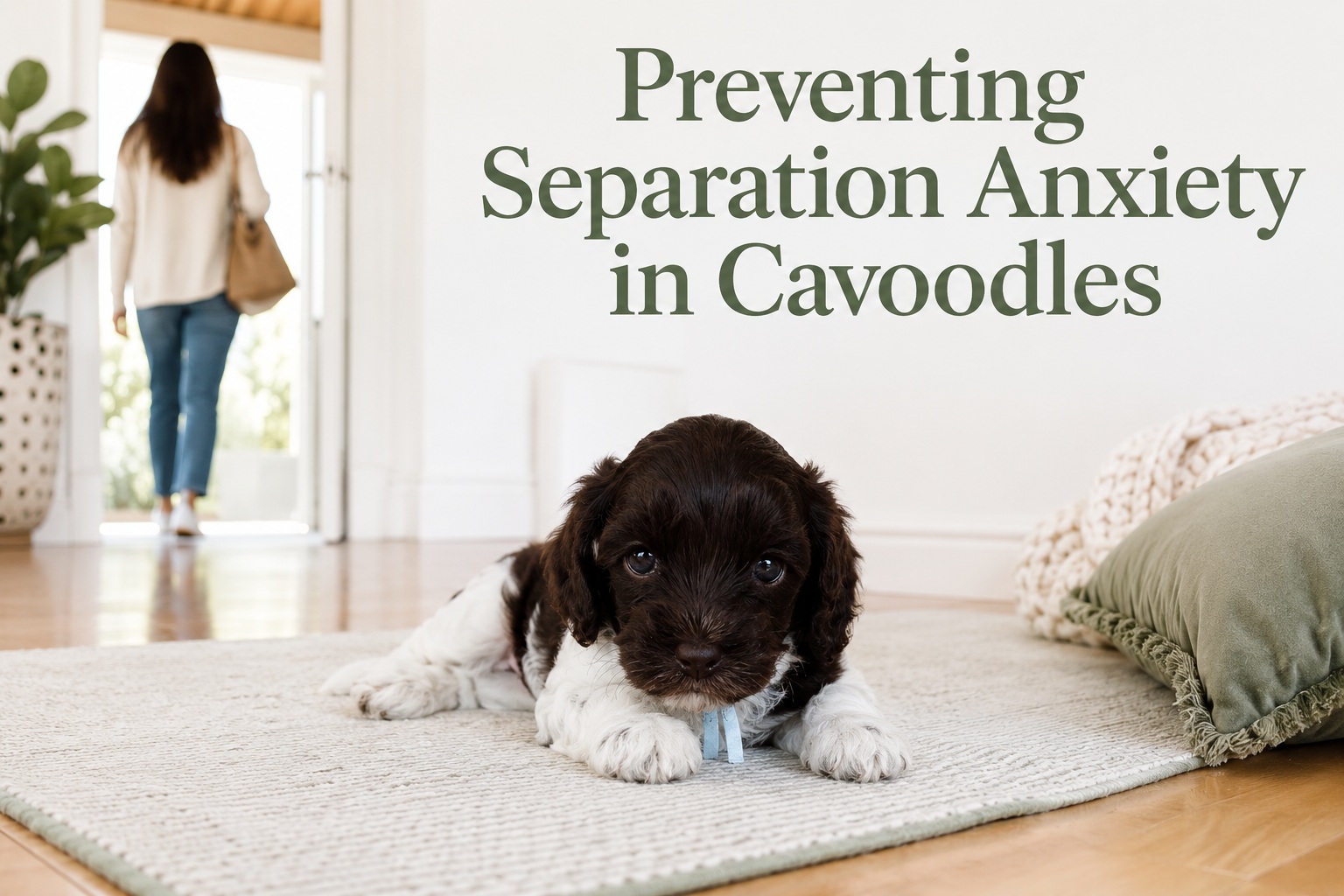
Bringing home a Cavoodle puppy is exciting, and it’s natural to want to spend as much time with them as possible during those first few weeks. However, one of the most valuable skills you can teach your puppy from an early age is that being alone for short periods is safe and normal.
Cavoodles are affectionate, people-oriented dogs. Their Cavalier King Charles Spaniel and Poodle heritage can contribute to dogs that enjoy close interaction with their families. That companionship is one of the reasons Cavoodles are so popular, but it also means owners should actively teach independence rather than assuming it will develop on its own.
Preventing separation-related problems isn’t about ignoring a frightened puppy or leaving them alone for hours. It involves gradual, positive experiences that help your Cavoodle become comfortable resting and spending time without constant human company.
At Glenroy Cavoodles, we believe this preparation starts during puppyhood and continues when your puppy joins your family.
Quick Answer: How Can You Help Prevent Separation Anxiety in a Cavoodle?
Start with very short, comfortable periods of independence and gradually increase them as your puppy becomes confident.
Give your puppy a secure place to rest, provide appropriate enrichment, establish a predictable daily routine and avoid suddenly changing from constant companionship to long periods alone.
Most importantly, work at your puppy’s pace. If they are becoming increasingly distressed, the exercise has progressed too quickly.
The aim isn’t to teach your Cavoodle that crying doesn’t work. The aim is to teach them that being alone isn’t frightening.
Why Can Cavoodles Find Being Alone Difficult?
Cavoodles are companion dogs. Many form close relationships with their owners and enjoy being involved in everyday family life.
A puppy also experiences a major transition when leaving the breeder.
Until that point, your puppy has generally been surrounded by their mother, littermates and familiar people, sounds and smells. Then, within a short period, everything changes.
They may have:
- A new home
- New people
- Different sounds and smells
- A different sleeping environment
- No littermates beside them
- A completely new routine
Some whining or uncertainty during this adjustment period isn’t unusual and doesn’t automatically mean a puppy has separation anxiety.
True separation-related distress can be more significant and may involve persistent vocalisation, attempts to escape, destructive behaviour, toileting, pacing or an inability to settle when separated from particular people.
This is why prevention and gradual independence training are valuable from the beginning.
Start Teaching Independence Early
One common mistake new puppy owners make comes from the best of intentions.
They bring their puppy home and spend virtually every minute together.
The puppy follows them around the house, sleeps beside them, sits on their lap while they work and accompanies them whenever they leave home.
For the first week or two, everything seems wonderful.
Then normal life resumes.
School starts again. Someone returns to work. The family goes shopping. Suddenly, the puppy that has rarely spent a moment alone is expected to cope with several hours without their people.
That’s a substantial change.
Instead, introduce small amounts of independence from the beginning, even when someone is home.
For example, your puppy might relax in their puppy pen with a safe enrichment activity while you’re elsewhere in the room. Later, you might briefly walk into another room and return.
These everyday experiences teach an important lesson:
My family can leave, and they come back. I am safe while they’re gone.
Begin With Seconds, Not Hours
Independence training doesn’t begin by leaving your puppy home alone for an afternoon.
It can begin with only a few seconds.
Place your puppy somewhere comfortable and secure when they are relaxed. Step away briefly and return.
As they become comfortable, gradually increase the duration.
You might progress from:
A few seconds → 30 seconds → one minute → several minutes → slightly longer periods
There is no need to follow an exact timetable. Your puppy’s behaviour should determine how quickly you progress.
If your Cavoodle remains relaxed, you can gradually make the exercise more challenging.
If they immediately become distressed, shorten the separation again.
Progress isn’t always perfectly linear. A puppy that comfortably spends several minutes alone one day may find it harder the next because they’re tired, overstimulated or adjusting to something new.
That’s normal.
Don’t Wait Until You Actually Need to Leave
Another useful approach is practising departure cues without always leaving the house.
Dogs are remarkably good at recognising patterns.
Your Cavoodle may eventually learn that:
- Picking up your keys
- Putting on certain shoes
- Packing your bag
- Closing your laptop
- Putting on a jacket
means you’re about to disappear.
For a dog already worried about being alone, these cues can trigger anxiety before you’ve even reached the door.
Occasionally perform ordinary departure-related actions without leaving.
Pick up your keys and put them down again. Put on your shoes and continue doing something around the house.
This helps prevent every departure cue from becoming a guaranteed signal that a long absence is coming.
Create a Comfortable Place for Your Cavoodle
Your puppy should have somewhere they can relax without needing constant physical contact with you.
Depending on your household and puppy, this might be:
- A puppy pen
- A puppy-proofed room
- A gated section of the house
- An appropriately introduced crate
- A comfortable bed or resting area
The space should feel safe rather than being used as punishment.
Include suitable bedding, access to water where appropriate and safe enrichment based on your puppy’s age and supervision needs.
You can also encourage your puppy to nap there while you’re still at home.
This helps them learn:
This is where I relax.
Rather than:
This is where I’m put whenever everyone disappears.
What About Crate Training?
Crates can be useful management and training tools when introduced positively, but a crate itself doesn’t prevent separation anxiety.
A puppy should gradually learn that the crate is a comfortable resting place.
Never assume that closing a distressed puppy inside a crate will teach independence. A puppy experiencing genuine panic may become even more distressed when physically confined.
For some dogs, a puppy pen or puppy-proofed room may be more appropriate.
The individual puppy matters more than following one particular training method.
Should You Let a Cavoodle Puppy “Cry It Out”?
This requires some balance.
A puppy may occasionally whine briefly because they would prefer to be beside you. That isn’t necessarily the same as emotional distress.
However, prolonged or escalating distress shouldn’t simply be ignored in the hope that the puppy will eventually give up.
Watch the whole puppy rather than focusing solely on whether they’re making noise.
Signs that the exercise may be too difficult can include:
- Persistent or escalating barking and crying
- Frantic scratching at doors or barriers
- Repeated escape attempts
- Heavy panting unrelated to heat or exercise
- Pacing
- Inability to settle
- Refusing something they would normally enjoy
- Extreme agitation when you prepare to leave
If this happens, your training may need to return to a much easier level.
The objective is confidence, not endurance.
Build a Predictable Puppy Routine
Young puppies generally benefit from consistency.
Their daily routine will usually revolve around:
Sleep → Toilet → Food → Play/training → Toilet → Rest
Puppies also need a considerable amount of sleep. An overtired puppy can become increasingly excitable, mouthy and difficult to settle.
Scheduled quiet periods can therefore serve two purposes: they help your puppy get sufficient rest while also teaching them that they don’t need constant entertainment from their family.
Try to make alone-time practice part of normal everyday life rather than something that happens only when the entire household leaves.
Exercise Helps — But Don’t Try to Exhaust Your Puppy
Providing appropriate physical activity can make settling easier, but trying to exhaust a puppy before leaving isn’t the solution.
Cavoodle puppies need age-appropriate activity rather than excessive exercise.
Mental enrichment can be equally valuable.
Depending on your puppy’s age, suitable activities may include:
- Short training sessions
- Sniffing and exploration
- Food puzzles
- Safe chew items
- Scatter feeding
- Simple scent games
A puppy that has had an opportunity to toilet, explore, use their brain and settle naturally may find quiet time easier.
Keep Departures and Homecomings Calm
Leaving home doesn’t need to become an emotional ceremony.
Similarly, returning home doesn’t need to involve several minutes of intense excitement.
You can certainly greet your puppy and be affectionate. The goal isn’t to ignore them.
Instead, treat departures and arrivals as normal parts of everyday life.
Over time, your Cavoodle can learn that people coming and going isn’t unusual or something to worry about.
How Long Can a Cavoodle Puppy Be Left Alone?
There isn’t a single number that applies to every Cavoodle puppy.
Age matters, but so do temperament, previous experiences, toilet-training progress and how gradually the puppy has been introduced to being alone.
A very young puppy shouldn’t be expected to cope with a full working day alone. Apart from the emotional challenge, young puppies need regular opportunities to toilet, eat, play, interact and rest.
As a general guide:
| Puppy Stage | What to Consider |
|---|---|
| 8–12 weeks | Keep alone-time training short and gradual. Puppies need frequent toilet breaks, supervision and companionship. |
| 3–4 months | Alone periods can gradually increase if the puppy is comfortable and coping well. |
| 4–6 months | Many puppies can manage longer periods, but they still need regular toilet, exercise and social breaks. |
| 6+ months | Independence can continue developing, but individual needs vary considerably. |
| Adult Cavoodle | A well-adjusted adult may cope with several hours alone, but shouldn't routinely be expected to spend an entire day without appropriate care, exercise and interaction. |
These aren’t targets your puppy must reach by a particular birthday.
A puppy calmly sleeping for an hour while you’re away is having a very different experience from a puppy spending that hour barking, pacing or trying to escape.
How comfortably your puppy copes is more important than simply watching the clock.
If work means your puppy will eventually need to spend longer periods at home, consider arranging help from family, a trusted pet sitter or dog walker, particularly while your Cavoodle is young.
Normal Puppy Behaviour vs Separation-Related Distress
Not every whine means separation anxiety.
Young puppies communicate vocally, particularly after moving away from their mother and littermates. A puppy may briefly whine when a door closes, protest about being placed in a pen or follow you from room to room.
What matters is the intensity, duration and pattern of the behaviour.
Behaviour that may occur during normal adjustment
A puppy might:
- Whine briefly before settling
- Prefer being near family members
- Follow you around the house
- Become excited when you return
- Need time to become comfortable sleeping independently
These behaviours don’t necessarily indicate a behavioural disorder.
Signs that deserve closer attention
More concerning behaviour may include:
- Persistent barking, howling or crying
- Frantic attempts to escape
- Scratching or biting doors and barriers
- Destructive behaviour concentrated around exits
- Persistent pacing
- Heavy panting or drooling when not explained by heat or exercise
- Toileting associated specifically with being left
- Refusing food or enrichment when alone
- Being unable to settle throughout your absence
- Becoming distressed as soon as departure preparations begin
One isolated incident isn’t enough to diagnose separation anxiety.
If these behaviours repeatedly occur specifically when your Cavoodle is left alone, it’s worth investigating further.
Use a Camera to See What Happens After You Leave
One of the most useful tools for independence training is something many families already own: a home camera.
Your puppy’s behaviour may change completely once the front door closes.
A camera can show whether your Cavoodle:
Settles and sleeps
or
Becomes increasingly distressed.
It can also reveal when difficulties begin.
For example, your puppy might comfortably spend 15 minutes alone but begin pacing at around 20 minutes. That information can help you structure future training sessions below the point where your puppy starts struggling.
Video can also be valuable if you later need advice from your veterinarian or a qualified behaviour professional.
Common Mistakes When Teaching a Cavoodle to Be Alone
Even well-intentioned owners can accidentally make independence more difficult.
1. Spending Every Minute Together at First
Taking time off work when bringing home a puppy can be extremely helpful.
The problem arises when the puppy spends several weeks with constant human company and then suddenly experiences an eight-hour absence.
Use some of your time at home to practise independence too.
2. Increasing Alone Time Too Quickly
If your puppy manages five minutes comfortably, that doesn’t necessarily mean they’re ready for an hour.
Build duration gradually.
Small successful experiences are usually more useful than repeatedly pushing your puppy beyond what they can handle.
3. Only Using the Puppy Area When Leaving
If the puppy pen or safe room always predicts your departure, your puppy may begin worrying as soon as they’re placed there.
Let your Cavoodle enjoy naps, chews and quiet time in the area while you’re still home.
4. Punishing Separation-Related Behaviour
Coming home to an accident or damaged item can be frustrating.
However, punishment after the event doesn’t teach a puppy how to feel comfortable alone.
If the behaviour is caused by distress, punishment may increase anxiety rather than resolve it.
5. Assuming Another Dog Will Fix the Problem
Some dogs enjoy canine companionship, but getting another dog isn’t a reliable treatment for separation anxiety.
If the puppy is distressed specifically by the absence of a particular person, another dog may make little difference.
6. Relying Entirely on Toys or Treats
Enrichment can help a relaxed dog enjoy alone time, but it doesn’t necessarily solve genuine separation distress.
A puppy that normally loves food but won’t touch a favourite enrichment toy after you leave may actually be showing you that the situation is too difficult.
What If Your Cavoodle Already Struggles When Left Alone?
If your puppy is already showing signs of difficulty, avoid repeatedly testing how long they’ll tolerate being alone.
Instead, reduce the challenge.
If they become uncomfortable after five minutes, training might temporarily involve separations lasting considerably less than five minutes.
The aim is to create repeated experiences where:
You leave → your puppy remains comfortable → you return.
Duration can then be increased gradually.
It may also help to identify whether particular parts of your routine trigger the response.
Does your Cavoodle become concerned when you:
- Pick up your keys?
- Put on work clothes?
- Open the garage?
- Pick up your handbag?
- Walk towards the front door?
Breaking these associations into smaller training exercises can sometimes make departures less significant.
When Should You Seek Professional Help?
Mild difficulty settling in a new home is very different from a dog experiencing severe separation-related distress.
Speak with your veterinarian if your Cavoodle shows persistent or intense signs such as:
- Panic when left alone
- Attempts to escape that could cause injury
- Persistent destructive behaviour
- Excessive drooling or panting associated with departures
- Repeated toileting despite otherwise appropriate toilet training
- Inability to eat when alone
- Severe or worsening vocalisation
- Behaviour that isn’t improving with gradual training
A veterinarian can also consider whether pain or another health issue could be contributing to behavioural changes.
Where appropriate, they may recommend working with a suitably qualified dog behaviour professional.
Severe separation anxiety isn’t simply a matter of a dog being “spoilt” or disobedient. Treatment may require an individual behaviour-management plan, and veterinary involvement can be important in more serious cases.
Can You Prevent Separation Anxiety Completely?
No breeder or owner can guarantee that a dog will never develop separation-related problems.
Behaviour is influenced by genetics, early experiences, learning, environment and circumstances throughout a dog’s life.
Major changes can sometimes affect dogs that previously coped well alone. These might include:
- Moving house
- Changes in working arrangements
- A family member leaving home
- Changes to household routine
- Periods when owners have been home continuously
- Ageing or health changes
That’s why independence is a useful skill to maintain throughout your Cavoodle’s life.
Even if you work from home, give your dog opportunities to relax independently rather than allowing them to become accustomed to being beside you every minute of every day.
Preparing Cavoodle Puppies for Family Life
The foundations for confidence begin before a puppy leaves for their new home.
Early puppy development should provide appropriate opportunities to experience everyday sights, sounds, handling, different surfaces and interactions in a safe and positive way.
At Glenroy Cavoodles, preparing puppies for family life is part of raising well-rounded companions.
But the breeder is only the beginning.
Once your puppy arrives home, continuing appropriate socialisation and gradually teaching independence helps them adapt to their new family and environment.
Breeder and owner therefore play complementary roles.
A Simple Independence Routine for New Cavoodle Owners
You don’t need to turn independence training into a complicated daily programme.
It can become part of ordinary life.
Morning: Toilet, breakfast, play and a short training session followed by quiet rest.
During the day: Encourage a nap or safe enrichment in the puppy’s own area while you do something elsewhere.
Independence practice: Step away briefly when your puppy is comfortable. Return calmly before the situation becomes overwhelming.
Later: Repeat another short, manageable separation rather than attempting one very long session.
Evening: Provide normal family interaction, appropriate activity and plenty of rest.
Over time, vary the circumstances. Your puppy should gradually learn that sometimes you’re nearby, sometimes you’re in another room and sometimes you leave the house—and all of these situations are safe.
Helping Your Cavoodle Become a Confident Companion
Cavoodles are loved for their affectionate and sociable personalities, but being close to their families shouldn’t mean they have to be beside someone every moment of the day.
Teaching independence is part of raising a confident dog.
Begin with tiny, manageable separations. Provide a secure environment, maintain a predictable routine and increase alone time according to your puppy’s behaviour rather than an arbitrary timetable.
Above all, don’t confuse independence training with forcing a frightened puppy to cope.
The goal is for your Cavoodle to gradually learn a simple lesson:
Being on my own for a while is safe, and my family comes back.
For Glenroy Cavoodles families, that process begins with a puppy’s early development and continues through patient, consistent training once they arrive in their new home.