
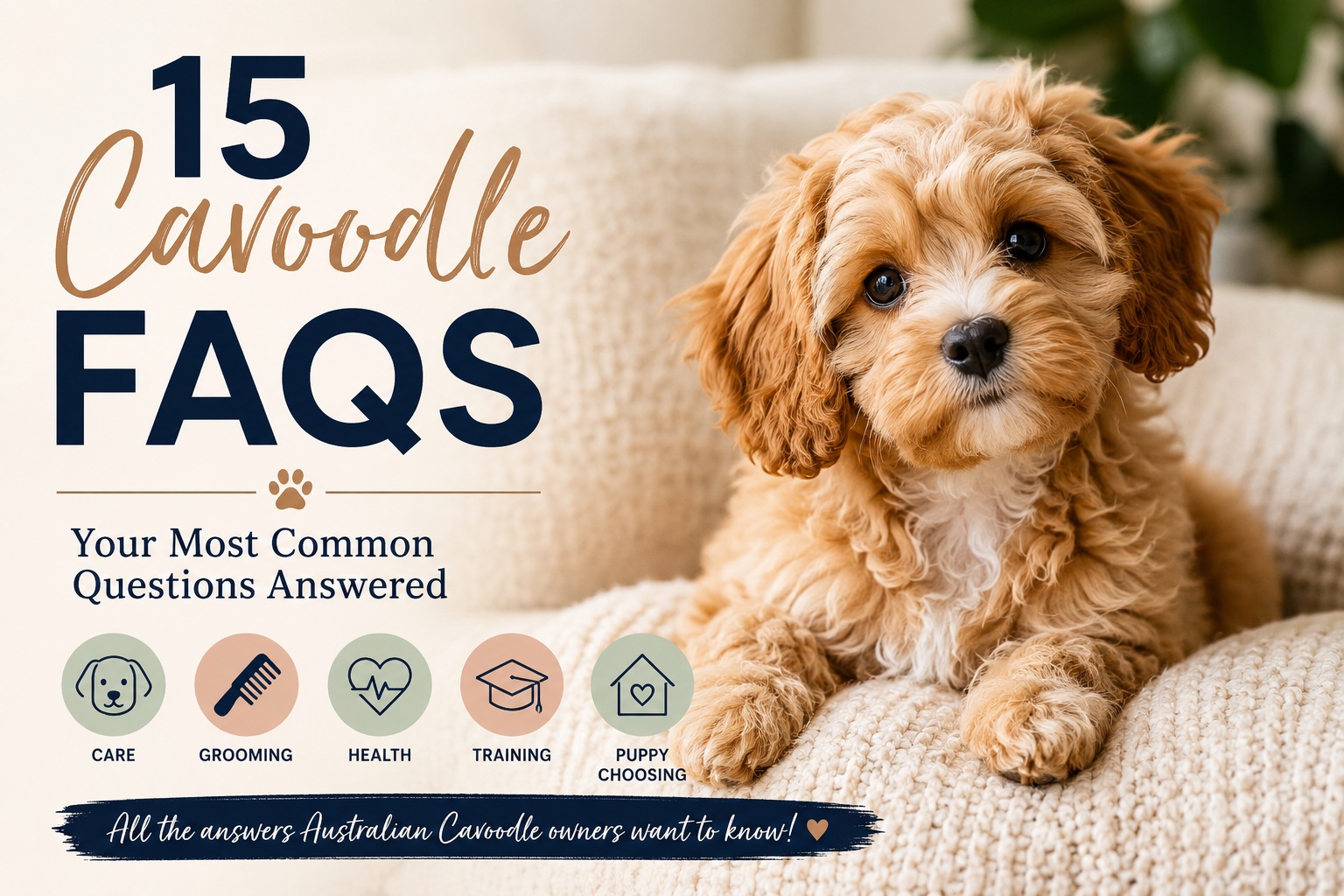
Cavoodles have become a popular companion dog for Australian households, combining characteristics of the Cavalier King Charles Spaniel and Poodle. Their affectionate nature, manageable size and people-focused temperament can make them well suited to many families, but prospective owners often have plenty of questions before bringing a puppy home.
How large will a Cavoodle become? Do they shed? Are they suitable for children? How much exercise and grooming do they need? And what should families know about their health and temperament?
This guide answers 15 of the most frequently asked questions about Cavoodles, starting with some of the basics prospective owners should understand.
15 Frequently Asked Questions About Cavoodles
1. What Is a Cavoodle?
A Cavoodle is a companion dog with Cavalier King Charles Spaniel and Poodle ancestry. They are also commonly called Cavapoos outside Australia.
Cavoodles may be first-generation crosses or come from later-generation and multigenerational breeding programs. As a result, individual dogs can vary in size, coat, shedding and temperament.
The Cavoodle is generally considered a Poodle cross rather than a formally recognised purebred breed. When choosing a puppy, it’s more useful to consider the parents, health testing, temperament and breeding program than relying on the generation label alone.
2. Are Cavoodles Good Family Dogs?
Yes, Cavoodles can make excellent family dogs. They are typically affectionate, playful, intelligent and strongly people-oriented.
They can suit families with children, couples, older owners and a range of home environments, provided their needs are met.
Cavoodles still require daily companionship, exercise, training, mental stimulation and regular grooming. Because they often form close bonds with their owners, families should also gradually teach puppies to feel comfortable spending reasonable periods alone.
Individual temperament varies, so choosing a puppy whose personality suits your household is important.
3. Are Cavoodles Good With Children?
Many Cavoodles are well suited to families with children, particularly when puppies receive good early socialisation and training.
Their smaller size and playful temperament can make them enjoyable companions, but interactions between dogs and young children should always be supervised.
Children should be taught not to pull ears or tails, disturb a sleeping or eating dog, or chase a puppy that wants to move away.
Puppies also need plenty of rest and a quiet space of their own. Matching the puppy’s individual temperament with the family’s lifestyle can be especially important in homes with young children.
4. How Big Do Cavoodles Grow?
Most Cavoodles are small dogs, although adult size can vary considerably depending on their parents and whether Toy or Miniature Poodles feature in their ancestry.
As a broad guide, many adult Cavoodles weigh approximately 5–12 kg, although some may fall outside this range.
Labels such as Toy Cavoodle and Mini Cavoodle can provide a general indication of expected size but aren’t guarantees.
One of the best ways to estimate a puppy’s eventual size is to ask the breeder about the size of the parents and other closely related adult dogs.
5. How Long Do Cavoodles Live?
Cavoodles commonly have a lifespan of around 10–15 years, although every dog is different.
Genetics, nutrition, maintaining a healthy weight, exercise, dental care and regular veterinary care can all influence long-term health.
Crossbreeding also doesn’t automatically guarantee a healthier dog. Cavaliers and Poodles can both carry inherited health conditions, which is why appropriate health testing and careful selection of breeding pairs are important.
Responsible breeding programs may also consider pedigree information and coefficient of inbreeding (COI) when planning pairings to help manage genetic diversity and make more informed breeding decisions.
6. Do Cavoodles Shed?
Cavoodles are often described as low-shedding dogs, but not every Cavoodle has the same shedding level.
Coat genetics are more important than simply whether a puppy is labelled F1, F1B or F2. One important factor is the furnishings gene, which influences the characteristic facial hair and coat associated with many Poodle crosses. Puppies inheriting two copies of the furnishing gene may be more likely to have a lower-shedding coat.
This is one reason experienced breeders may use genetic information when planning pairings rather than relying on generation labels alone.
Even low-shedding Cavoodles still require regular brushing and professional grooming.
7. Are Cavoodles Hypoallergenic?
No dog can be guaranteed to be completely hypoallergenic, including a Cavoodle.
Some Cavoodles shed relatively little and may be better tolerated by certain people with dog allergies. However, allergic reactions can be triggered by proteins found in dander, saliva and urine, not simply loose hair.
Coat type and shedding can also vary between individual Cavoodles.
If someone in your household has a significant dog allergy, it’s sensible to spend time around Cavoodles before committing to a puppy and discuss your individual allergy concerns with an appropriate health professional.
8. How Often Do Cavoodles Need Grooming?
Cavoodles generally require regular coat maintenance throughout their lives.
Most need brushing several times a week to help prevent knots and matting, particularly around the ears, legs, chest, tail and areas where a harness or collar sits.
Professional grooming is commonly required approximately every 6–8 weeks, although this varies with coat type, length and the style you prefer.
Owners should also regularly check their Cavoodle’s ears, nails, eyes and teeth.
Introducing brushing, bathing, nail handling and other grooming routines while your Cavoodle is still a puppy can make grooming much easier as they grow.
9. How Much Exercise Does a Cavoodle Need?
Cavoodles may be small, but they still need daily physical activity and mental stimulation.
Most adult Cavoodles enjoy daily walks combined with play, training and opportunities to explore. Their exact exercise needs depend on age, size, health and individual energy level.
Puppies require a different approach. Rather than long or strenuous exercise sessions, they benefit from shorter periods of age-appropriate activity, training and play throughout the day.
Mental exercise matters too. Food puzzles, scent games and short training sessions can help keep an intelligent Cavoodle occupied.
10. Are Cavoodles Easy to Train?
Cavoodles are generally intelligent and responsive to training, particularly when positive, reward-based methods are used.
Starting early can help establish good habits around toilet training, recall, walking on a lead, settling calmly and interacting appropriately with people and other dogs.
Keep training sessions short, consistent and enjoyable. Puppies often learn more effectively through several brief sessions than one long training period.
Early socialisation is equally important. Carefully introducing a puppy to different people, sounds, surfaces, environments and everyday experiences can help them develop into a confident adult dog.
Training should continue beyond puppyhood—Cavoodles benefit from ongoing learning and mental stimulation throughout their lives.
11. Can Cavoodles Be Left Alone During the Day?
Cavoodles are typically people-focused dogs and can form strong bonds with their families. They can learn to spend time alone, but this should be introduced gradually from puppyhood.
Start with short periods and build up slowly, helping the puppy learn that being alone is safe and temporary. Providing a comfortable resting area, enrichment and an appropriate routine can also help.
Regularly leaving a Cavoodle alone for very long periods may not suit every dog. Families who work away from home should consider how exercise, toilet breaks and companionship will be managed during the day.
12. What Health Problems Can Cavoodles Have?
Like all dogs, Cavoodles can develop health problems. Conditions relevant to their Cavalier and Poodle ancestry may include eye disorders, heart conditions, joint problems and certain inherited genetic conditions.
This doesn’t mean every Cavoodle will develop these problems.
Responsible breeding involves assessing the health of breeding dogs and completing appropriate health and genetic testing before planning a litter. Breeders may also consider pedigrees and coefficient of inbreeding (COI) when evaluating potential pairings.
Prospective owners should ask breeders what health testing has been completed on the parents and request supporting documentation where appropriate.
13. What Is the Difference Between F1, F1B, F2 and Multigenerational Cavoodles?
Cavoodle generation labels describe how dogs within a breeding program are related.
An F1 is traditionally a Cavalier King Charles Spaniel × Poodle cross, while an F1B usually involves breeding an F1 back to a Poodle. Later generations can become more complicated.
For example, an F2 does not always mean a simple F1 × F1 pairing. In generational breeding programs, an F4 Cavoodle bred to an F1 Cavoodle can also produce an F2 litter, depending on how generations are classified.
Generation alone doesn’t determine coat, shedding, health or temperament. Parent genetics, furnishings, health testing, COI and the breeder’s overall breeding strategy provide much more useful information.
14. What Should I Look for When Choosing a Cavoodle Breeder?
A responsible Cavoodle breeder should be willing to explain how and why they plan their litters, rather than focusing only on colour, size or appearance.
Ask about:
- Health and genetic testing of breeding dogs
- Parent temperament
- Puppy socialisation and early development
- Coat and furnishing genetics where relevant
- Pedigrees and breeding decisions
- Veterinary care
- Contracts and ongoing breeder support
A good breeder should also be comfortable answering detailed questions and asking questions about you. Their priority should be finding suitable homes for their puppies rather than simply completing a sale.
15. How Do I Choose the Right Cavoodle Puppy for My Family?
Choosing the right Cavoodle involves more than selecting your favourite colour or the first puppy that approaches you.
Consider your household, children, activity level, work schedule, grooming expectations and experience with dogs. Individual puppies within the same litter can differ in confidence, energy and temperament.
A breeder who has spent considerable time raising and observing the litter may be able to help identify puppies that are likely to suit different households.
Ultimately, the best Cavoodle for your family is one whose temperament, expected size, coat characteristics and needs fit realistically with your lifestyle.
Final Thoughts
Cavoodles can be affectionate, intelligent and highly rewarding family companions, but choosing one should still be a carefully considered decision.
Understanding their grooming, exercise, training, health and companionship needs before bringing a puppy home can help families prepare for life with their new dog.
Just as importantly, prospective owners should look beyond simple labels such as F1, F1B or F2. Responsible breeding considers the individual dogs being paired, their health and temperament, genetic traits and the qualities the breeder hopes to maintain or improve in future generations.
Taking the time to research both the Cavoodle and the breeder can give your puppy the best possible start and help you find a companion that fits comfortably into your family for many years to come.